White paper · Euler × Danish Technological Institute
77% less time lost to failed builds when you stop at Euler’s alert
With the Danish Technological Institute, Euler watched 54 builds on four metal powder-bed printers. Stopping each failed build when Euler predicted the critical failure would have saved about 10 of the 13 days those builds used.
What the paper found
Measured on 54 real builds
DTI’s builds were a mix of production and experiments, on four printers over 47 days of print time. Two experts, one of them from DTI, checked the results. Each figure is quoted from the paper, with the page it is on.
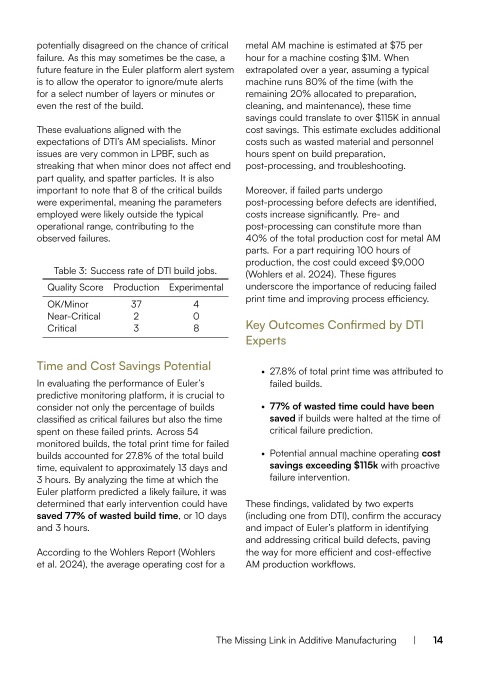
27.8%of all print time in the study went to builds that failed.
Many of those were experiments that push the process on purpose.
Page 1477%of the print time lost to failed builds would have been saved by stopping at Euler’s critical alert.
That is about ten days of machine time, across the 54 builds DTI monitored.
Page 14$115k+a year in machine operating cost could be saved by stopping failed builds early.
Estimate using the Wohlers Report’s $75 an hour for a $1M machine running 80% of the time. Material, labor and post-processing are not included.
Page 14- First critical alert160
- Last chance to intervene184
- Failure195
21 minof warning before a warping part hit the recoater, in the paper’s example build.
That is 24 layers of notice: enough to pause the build before the collision. Page 10
38 hoursof printing would have been saved from scrap on one build, by stopping at Euler’s alert.
DTI had already gone through that build by hand and not found the error. Page 15
The study
Four printers, six materials, every build watched
Euler ran on all four of DTI’s metal printers and checked every layer of every build. That came to 54 builds: real production work alongside experiments that push the process on purpose.
- OK or minor4175.9%
- Near-critical2
- Critical11
41 of 54 builds finished OK or with minor issues.
Eleven were critical and the rest near-critical. Eight of the critical builds were experiments, run with parameters likely outside the normal range. From the paper’s table 3.
- Ti6Al4V21
- 316L18
- AlSi10Mg10
- CuCr1Zr3
- CP11
- IN6251
Six materials, from titanium to copper alloys.
Ti6Al4V and 316L made up most of the builds, with AlSi10Mg, CuCr1Zr, CP1 and IN625. From the paper’s table 2.
From DTI
DTI on Euler

DTI on running Euler on every machine.
The Danish Technological Institute’s customer spotlight, three minutes with captions.
“Euler is close to perfect in spotting the issues. We have already adopted Euler on all our machines and the vision is to switch completely to automatic QA reporting from machine data.”

What’s inside
What’s in the paper
By Hildur Einarsdottir, Eythor Eiriksson, Valtyr Kjartansson and Eirikur Eiriksson of Euler, and Karl Frederik Færch Fischer and Jeppe Skinnerup Byskov of the Danish Technological Institute.
PDF · 21 pages · 48 MB · 2025
- Management summaryThe study and its results on one page.Page 03
- IntroductionWhy failure rates and qualification hold back laser powder bed fusion.Page 05
- Real-time process monitoring in additive manufacturingReal-time against post-build analysis, and cloud against on-premises.Page 07
- Detection of critical defects in LPBF imagesThe defect types common in powder-bed images, with examples.Page 08
- Predicting future layer statusAn example build with a 24-layer warning before a recoater collision.Page 10
- Validating performance in collaboration with DTIThe 54 builds, their results, and the time and cost savings.Page 13
- Critical build exampleA production build DTI investigated after a customer complaint.Page 15
- The way forwardSummary and next steps.Page 17
Read the full paper
The study, the numbers behind every figure on this page, and the build DTI could not find the error in by hand.
Or book a demo on your own builds